RF microneedling vs microneedling
RF microneedling vs microneedling: what does the heat add?
Both treatments push fine needles into the skin. Plain microneedling stops there, and the punctures alone start the repair. RF microneedling, the group Potenza belongs to, also sends radiofrequency current through the needles, so the tissue around each tip heats and coagulates. In a randomised split-face trial of Sylfirm X, another RF microneedling device, used at the same needle depth on both sides of the face with the energy set to zero on one, the RF side improved sooner and on more skin measures. Side effects were mild on both sides and lasted from 10 minutes to 7 days.[1]
The Potenza Seoul team edits these guides. Editorially updated: .
Watch the same needles with the RF off and on
Two patches of skin receive the same needle tip at the same depth. On one patch the needles enter and withdraw with no current; on the other, radiofrequency current passes between neighbouring needle tips and heats the tissue around them before the needles withdraw.
Transcript
- Two patches of skin, each under the same needle tip.
- On both patches the needles enter the skin to the same depth.
- On the left patch no current flows. On the right, radiofrequency current passes between neighbouring needle tips and heats the tissue around them.
- The needles withdraw. The left patch keeps narrow channels; the right also keeps small heated zones around each channel.
- Ask your clinician about pain, side effects and contraindications.
What is the difference between RF microneedling and microneedling?
Microneedling uses tiny needles to puncture the skin, and the body answers by making collagen. Radiofrequency microneedling, in the words of the American Academy of Dermatology, “adds heat to your treatment. The heat travels down the needles” (AAD page on microneedling, checked 24 October 2026).
FDA records draw the same line. Its November 2020 guidance on microneedling products identifies a microneedling device for aesthetic use as one “using one or more needles to mechanically puncture and injure skin tissue”, and puts “needle probes that emit any type of energy (e.g., radio-frequency needles)” outside its scope (FDA guidance issued 10 November 2020, checked 24 October 2026). Potenza’s own summary, K192545, describes RF at 1 or 2 MHz delivered through an electrode tip, where it “generates an electrothermal reaction which is capable of coagulating the tissue” (K192545 device description, checked 24 October 2026).
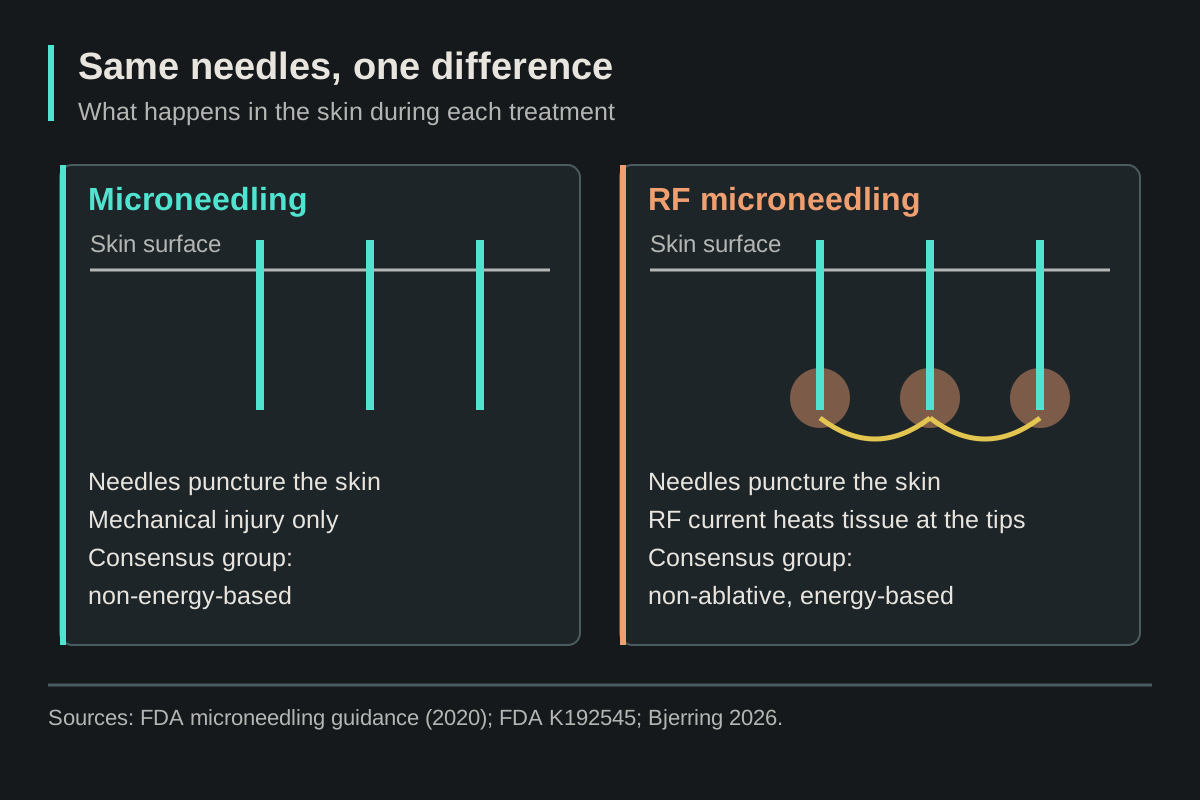
A 2026 international consensus on skincare around cosmetic procedures sorts them the same way: RF microneedling with the non-ablative energy-based procedures, plain microneedling with the non-energy-based procedures that disrupt the skin barrier.[2] What the heat leaves behind has been examined under the microscope. Needle-delivered bipolar RF in human skin left zones of denatured collagen in the deep dermis that were still visible on day 28 and had been replaced by new dermal tissue by 10 weeks.[3] How Potenza sets mode, frequency and depth is covered in how Potenza works.
What happened when a trial switched the RF off on one side?
A 2025 trial at Seoul National University Hospital treated 30 Korean women aged 60 to 71 on the skin between the outer corner of the eye and the hairline: four sessions, four weeks apart. One side of the face, chosen at random, had RF microneedling at a 1 mm depth. The other side had the same needling at the same depth with the energy set to zero. Neither the women nor the assessors knew which side was which, and 29 completed the study.[1]
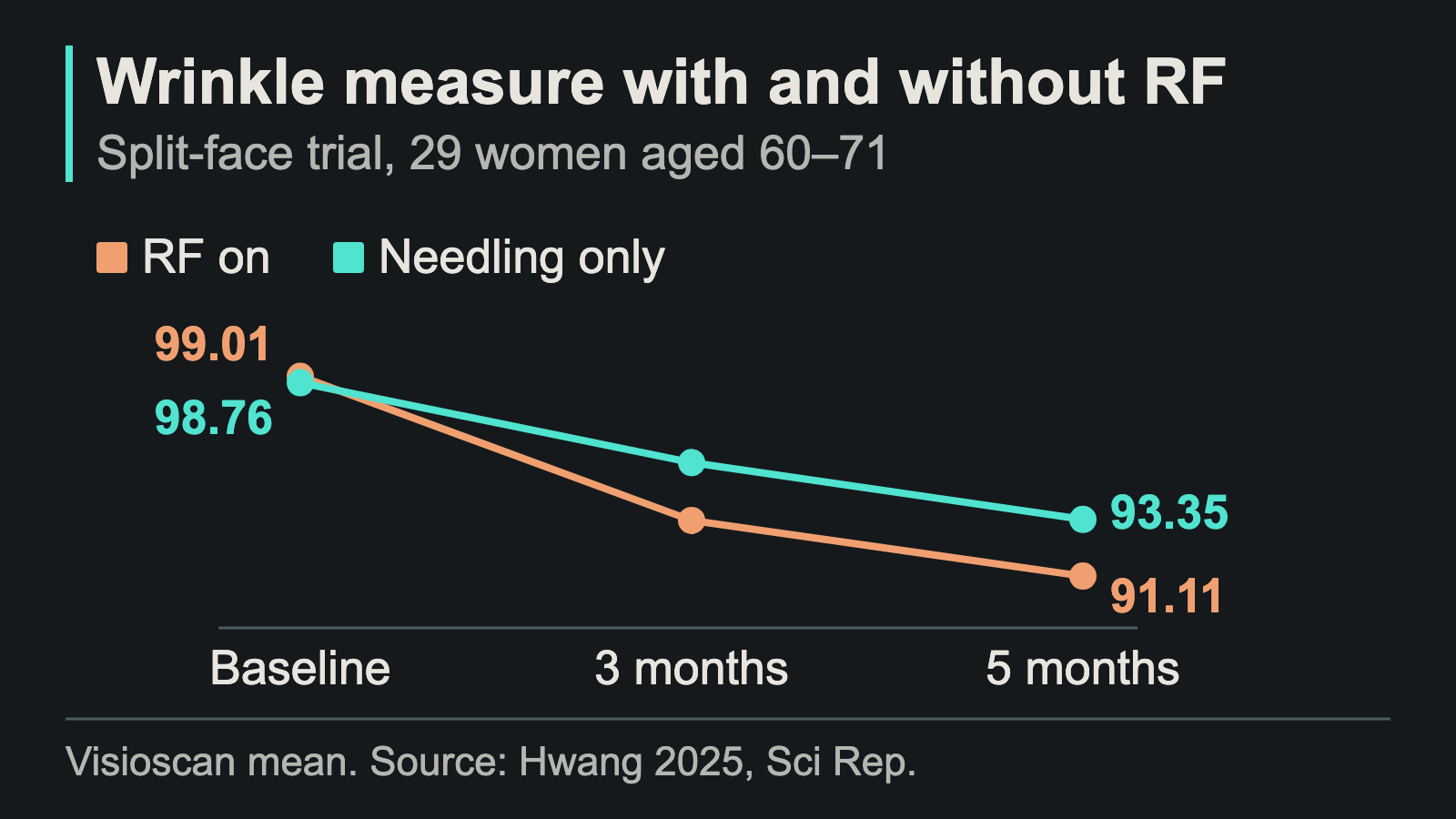
By the five-month mark, two months after the last session, the wrinkle measure had improved on both sides. At three months only the RF side had changed significantly from its own starting value (p = 0.0005, against p = 0.284 for needling alone). Skin hydration rose and water loss through the skin fell significantly only on the RF side. Biopsies taken two months after the last session showed more collagen and elastin in the upper dermis on the RF side than on the needling-only side, with no significant difference deeper down.[1]
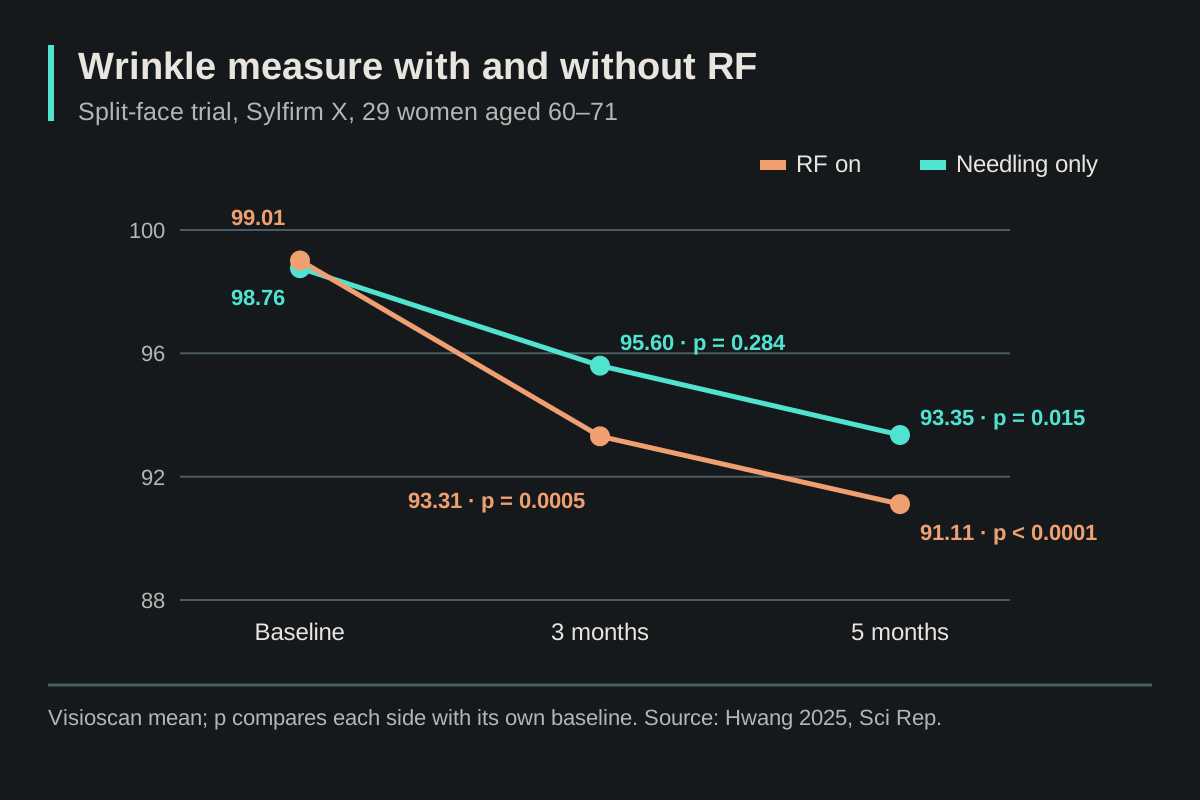
The device was Sylfirm X, not Potenza, and the last measurements came two months after the final session.[1]
Does adding RF mean more redness or downtime?
In that trial, side effects were mild on both sides, lasted from 10 minutes to 7 days and mostly settled with cold compresses. Immediate redness appeared on 4 of 29 RF-treated sides and none of the needling-only sides, a difference that did not reach statistical significance (p = 0.056).[1]
For microneedling in general, the American Academy of Dermatology describes redness or darker shades, a sunburn-like feeling and swelling that usually settle within a few days to a week, and asks patients to wait 24 hours before wearing makeup. Day-by-day care after Potenza is in sessions, downtime and aftercare.
Which works better for acne scars?
Both can help. A systematic review of nine randomised trials found microneedling improved atrophic acne scars on its own or with other treatments, with no serious side effects reported; it included both rollers and fractional RF microneedling.[4]
A 2026 review of 27 studies with 1,137 participants set needling against ablative fractional lasers. For atrophic acne scars, lasers such as fractional CO2 often suggested greater improvement than microneedling, while needling brought shorter downtime and fewer pigment side effects. RF microneedling came closer to the laser results in several individual studies.[5] Results from Potenza scar trials are in Potenza for acne scars.
Is SkinPen RF microneedling?
No. FDA record DEN160029, dated 1 March 2018, describes the SkinPen Precision System as a motor-driven microneedling pen with a sterile 14-needle cartridge, depth settings from 0 to 2.5 mm and rechargeable batteries as its energy source. The device type the record defines uses needles that “mechanically puncture and injure skin tissue”, and the record describes no radiofrequency output (FDA record DEN160029, checked 24 October 2026).
How do you choose between them?
| Point of comparison | Microneedling | RF microneedling |
|---|---|---|
| What the needles do | Puncture the skin | Puncture the skin and carry current that heats tissue at the tips |
| Group in a 2026 consensus | Non-energy-based, disrupts the skin barrier | Non-ablative, energy-based |
| Split-face trial, wrinkle measure | Significant change by 5 months | Significant change by 3 months |
| Side effects in that trial | Mild, 10 minutes to 7 days | Mild, 10 minutes to 7 days |
| Acne scars against ablative lasers | Lasers often suggested greater improvement | Closer to laser results in several studies |
The choice turns on the target and the reaction you accept. In the split-face trial, adding heat brought measurable changes sooner; in the scar review, needling traded some of the effect of ablative lasers for shorter downtime and fewer pigment problems, with RF microneedling closer to the laser results. Because the academy counts RF microneedling as a type of microneedling, ask whether the needles planned for you carry current at all, and which device, mode and depth will be used. For the same steps on the face, there is a short film of Potenza on the cheek.
Is RF microneedling better than microneedling?
In a randomised split-face trial that kept the device and needle depth the same and set the energy to zero on one side, the RF side improved sooner and on more skin measures over five months. That trial used Sylfirm X on the skin beside the eyes of women aged 60 to 71.[1]
Is the recovery longer after RF microneedling?
In the same trial, side effects lasted from 10 minutes to 7 days on both sides. Immediate redness was seen on 4 of 29 RF-treated sides and none of the needling-only sides, a difference that was not statistically significant.[1]
Can plain microneedling treat acne scars?
Yes, in randomised trials it improved atrophic acne scars alone or combined with other treatments. Against ablative fractional lasers, lasers often suggested greater improvement, while needling had shorter downtime.[4][5]
Is SkinPen RF microneedling?
No. FDA record DEN160029 describes SkinPen Precision as a motor-driven microneedling pen powered by rechargeable batteries, and it describes no radiofrequency output.
References
(5)
Bibliographic records retrieved from PubMed (U.S. National Library of Medicine).
Hwang JM, Lee SH, Baek EJ, et al. Comparison of the effects of fractional microneedle radiofrequency and microneedling on modulating the senescent fibroblast milieu in aged skin. Sci Rep. 2025;15(1):18296.
Bjerring P, Draelos ZD, Fabi SG, et al. International Expert Consensus on Integrated Skincare Active Ingredients for Pretreatment and Posttreatment Use With Medical Aesthetic Procedures to Enhance Skin Benefits. J Cosmet Dermatol. 2026;25(5):e70880.
Hantash BM, Ubeid AA, Chang H, et al. Bipolar fractional radiofrequency treatment induces neoelastogenesis and neocollagenesis. Lasers Surg Med. 2009;41(1):1-9.
Sitohang IBS, Sirait SAP, Suryanegara J. Microneedling in the treatment of atrophic scars: A systematic review of randomised controlled trials. Int Wound J. 2021;18(5):577-585.
Almahzoum K, Alfailakawi W, Alharran AM, et al. Comparative Efficacy and Safety of Needling-Based Therapies Versus Ablative Fractional Lasers for Scar Management: A Systematic Review and an Exploratory Meta-Analysis. Photodermatol Photoimmunol Photomed. 2026;42(5):e70121.